
A governed Discovery and Transition approach that removes handover risk, stabilises services, and sets clear ownership from day one.
Request a Discovery & Transition reviewWhen support is delivered without strong governance, organisations quickly feel the impact; unclear ownership, inconsistent processes, risky handovers, and service levels that vary depending on who is on duty. These challenges are amplified in complex Microsoft business application environments, where competing priorities make it difficult to maintain stability, drive improvement, and keep accountability clear.
Codec removes this uncertainty through a fully governed, ITIL‑aligned Discovery and Transition framework. Backed by structured transition planning, centralised oversight, defined SLAs, and active risk management, our approach establishes operational maturity from the outset. With specialist Microsoft expertise and dedicated Managed Service professionals, Codec provides greater service stability, clear ownership, and ongoing improvement from day one, helping your applications scale with confidence.
From understanding what you have to supporting it properly, without disruption.
Our approach is built around two tightly connected phases:
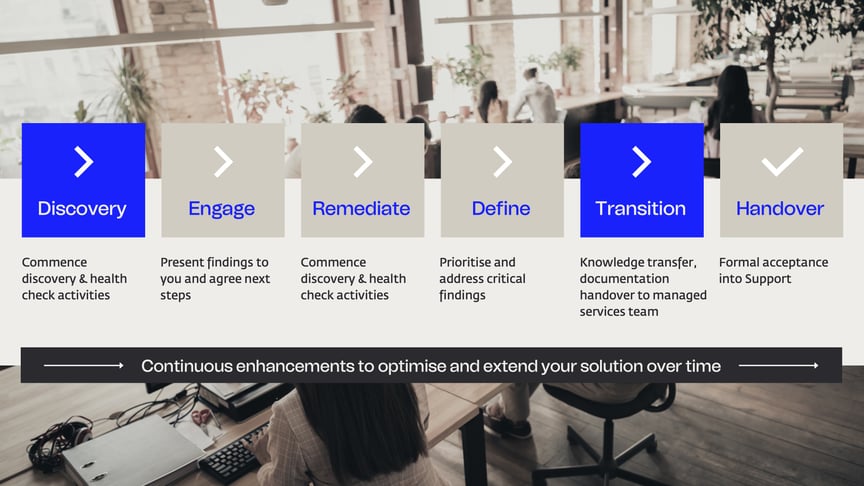
Discovery leaves you with practical, actionable outputs even if you decide not to proceed with Managed Services.
You'll receive:
These outputs are yours to use internally, with suppliers, or as a foundation for a managed service transition.
Our transition framework provides a controlled, low risk move from your incumbent supplier or internal team into Codec's managed service. It protects business continuity while quickly establishing clear ownership, measurable service performance, and consistent ways of working.
Following discovery, we guide the transition through a proven, governed process designed to minimise risk and accelerate stability.
Our transition approach transfers responsibility in a structured, phased way, ensuring continuity for users while laying the foundations for a stable, fully governed managed service.
Clear ownership is established from the outset, with defined decision making, escalation paths, and risk management. This ensures the transition is controlled, accountable, and actively managed at every stage.
We define what is transitioning, how it will be supported, and how success will be measured. Service scope, responsibilities, SLA, reporting and change processes are designed to align with your operation model.
Critical knowledge is captured and validated through structured walkthroughs and documentation. This ensures support teams are fully prepared and reduces dependency on individuals or incumbent suppliers.
Support responsibilities are transferred in phases, aligned to your risk tolerance and business priorities. Where required, we run alongside existing teams to maintain continuity and minimise disruption.
Following handover, we enter a stabilisation period focused on service performance, user experience, and issue resolution. Once stability is proven, the service transitions into steady-state managed support.
This approach is designed for organisations running Microsoft Business Applications such as Dynamics 365, Power Platform, and related integrations.
Discovery reduces transition risk by creating a clear, shared understanding of your current applications, documentation gaps, security model, integrations, and support readiness.
The timeline depends on the size and complexity of your application estate, but Discovery is desinged to be structured and efficient. The goal is to gather information needed to support safely and confidently, without unnecessary overhead.
We typically begin with access to existing documentation, an overview of your applications, and visibility into recent support tickets. From there, we'll confirm exactly what access and information is required at each stage.
Service performance is managed through agreed SLAs, KPIs, and reporting covering stability, responsiveness and user satisfaction. Governance and escalation processes are embedded from day one.