Transition Microsoft Business Applications with confidence
Move from uncertainty to fully governed support with a structured Discovery and Transition approach for Microsoft Business Applications.
Codec helps you understand your current application landscape, identify risks and gaps, and move safely into a managed service model with clear ownership, defined service levels and minimal disruption.
Why Discovery and Transition matters
When responsibility for business application support is unclear, organisations can quickly face inconsistent processes, risky handovers, knowledge gaps and varying service levels. This becomes even more challenging in complex Microsoft environments, where applications, integrations, security models and business processes are all closely connected.
Codec’s Discovery and Transition approach gives you a controlled path into Managed Services. We assess your current environment, identify what needs to be addressed, and transition support in a structured way so your teams gain clarity, continuity and confidence from the outset.
Two phases, one controlled path to Managed Services
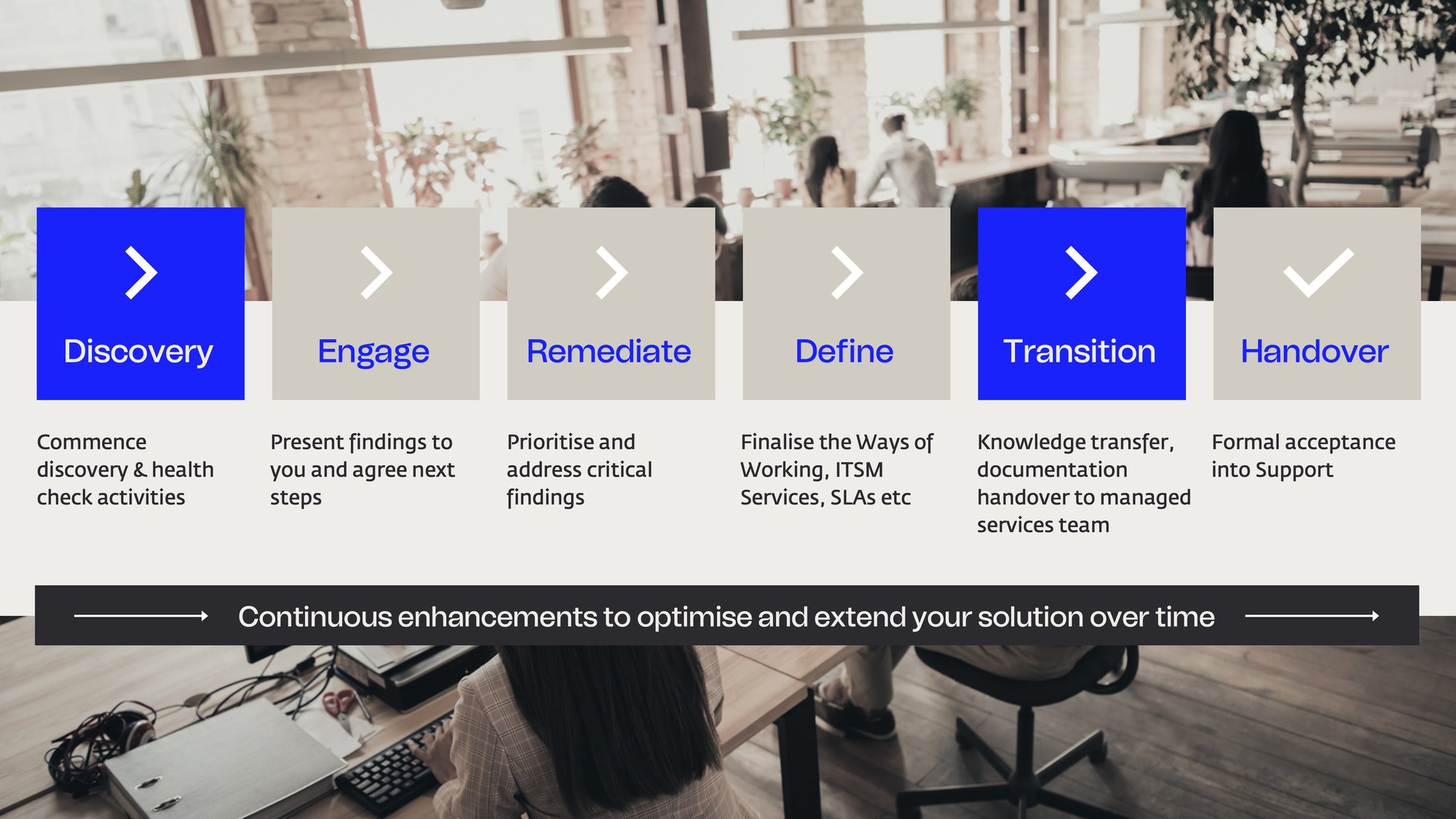
Our approach is built around two connected phases:
Discovery:
Discovery gives you a clear view of your Microsoft Business Applications, how they are currently supported, where risks exist, and what needs to be improved before transition. It helps reduce uncertainty by identifying documentation gaps, support dependencies, recurring issues, security considerations and areas for optimisation.
Transition:
Transition moves responsibility into Codec’s Managed Service through a structured, governed process. We establish ownership, service processes, knowledge transfer, reporting, SLAs and early-life support so your service can move into BAU with less risk and greater consistency.
What you gain from Discovery
Before transitioning support, it's essential to understand how your applications operate, where risks exist and what is needed for long-term support success. Discovery gives you that visibility.
We evaluate the operational, technical and governance factors that affect support readiness and transition risk, providing a complete picture of your current environment.
Gain a clear understanding of your applications, dependencies, support processes and risks before transitioning support.
Identify risk early
Uncover documentation gaps, security concerns and operational dependencies before transition.
Strengthen support foundations
Ensure knowledge, governance and processes are in place for long-term success.
Improve operational resilience
Identify recurring issues, release risks and operational gaps that could impact application performance.
Plan the next steps
Leave with a practical roadmap for support, optimisation and continuous improvement.
At the end of Discovery, you receive actionable outputs that can be used to support internal planning, supplier conversations or a Managed Service transition.
You will receive:
A comprehensive Health check highlighting risks, issues and recommended remediation.
A prioritised improvement roadmap covering refactoring, upgrades, security and optimisation.
Clear visibility of support readiness and transition risk, so there are no surprises later.
These outputs help you understand what needs to be fixed, improved or governed before support is transitioned.
Transition to Managed Services with confidence
Our transition framework provides a controlled, low risk move from your incumbent supplier or internal team into Codec's managed service. It protects business continuity while quickly establishing clear ownership, measurable service performance, and consistent ways of working.
Following discovery, we guide the transition through a proven, governed process designed to minimise risk and accelerate stability.
How the transition process works
Codec’s Transition Framework delivers a controlled, low-risk move to Managed Services, ensuring business continuity, clear ownership and measurable service performance.
1.
Centralised governance
Establish governance, ownership, oversight, KPI monitoring and risk management.
2.
Service design
Define scope, responsibilities, SLAs, reporting and ITSM alignment.
3.
Knowledge transfer
Capture knowledge through workshops, runbooks, documentation and handover plans.
4.
Migration
Transition services in phases to minimise risk and maintain continuity.
5.
Stabilisation
Monitor performance, resolve issues and support transition to BAU service.
Ready to remove uncertainty from your move to Managed Services?
Start with Discovery and gain a clear, governed path to stable Microsoft Business Application support.
Request a Discovery & Transition overview.
Frequently asked questions
Why is a Discovery phase necessary before transitioning support?
Discovery reduces transition risk by creating a clear, shared understanding of your current applications, documentation gaps, security model, integrations, and support readiness.
How long does the Discovery phase typically take?
The timeline depends on the size and complexity of your application estate, but Discovery is designed to be structured and efficient. The goal is to gather information needed to support safely and confidently, without unnecessary overhead.
What do you need from us to get started?
We typically begin with access to existing documentation, an overview of your applications, and visibility into recent support tickets. From there, we'll confirm exactly what access and information is required at each stage.
How is service performance managed after transition?
Service performance is managed through agreed SLAs, KPIs, and reporting covering stability, responsiveness and user satisfaction. Governance and escalation processes are embedded from day one.
/Codec%20-%20Website%20Assets/codec-white-logo.svg)

/Codec-logo.svg "Codec Logo")