/Codec-logo.svg "Codec Logo")
/Codec%20-%20Website%20Assets/codec-white-logo.svg)
/Codec%20Labs/Dynamics365_BC_Ireland_panel2.jpg)
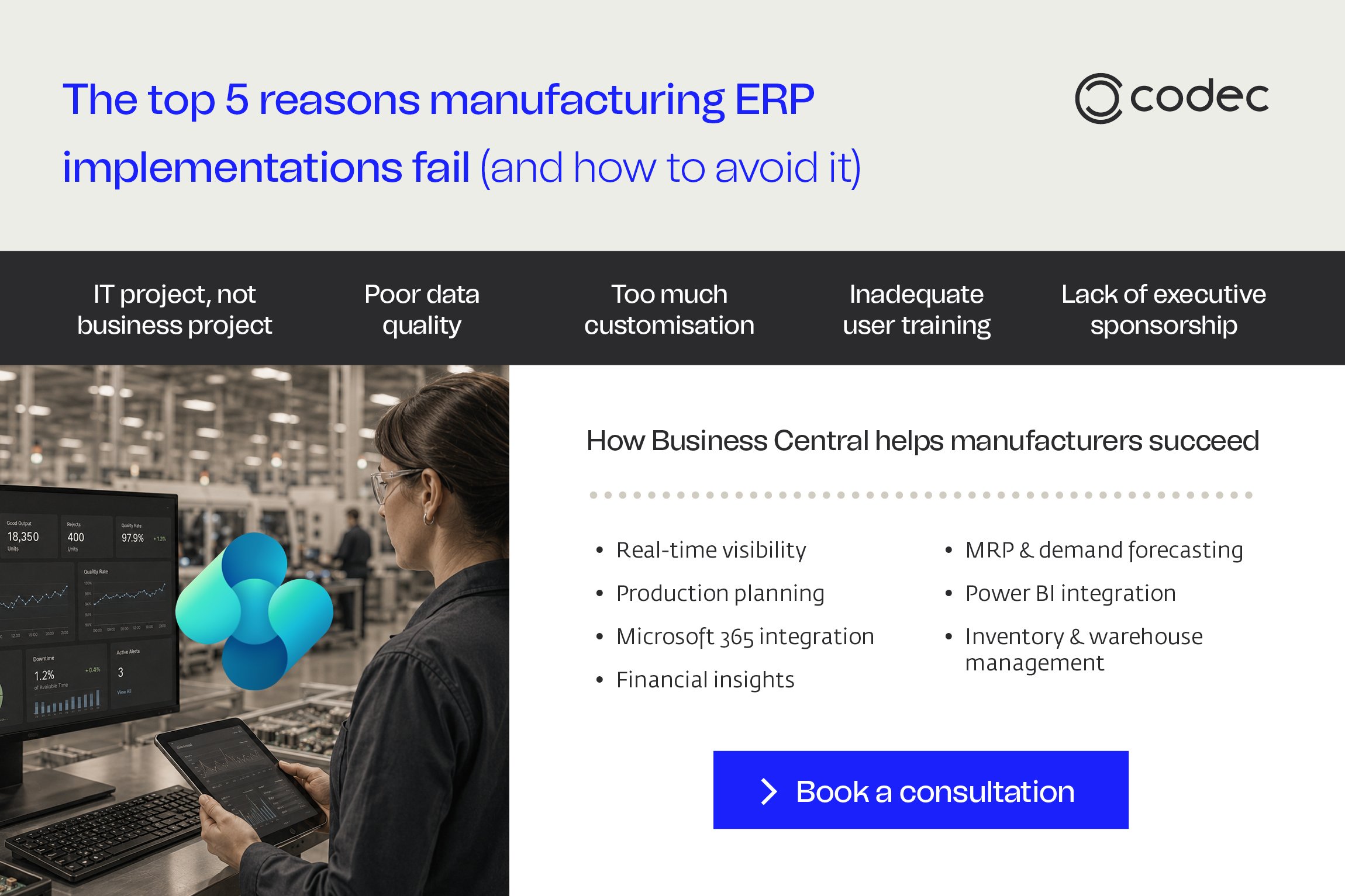
Many manufacturing companies invest in a new ERP system expecting immediate improvements in efficiency, visibility, and profitability. Yet industry research consistently shows that ERP projects often exceed budgets, miss deadlines, or fail to deliver the expected business value.
The good news? Most ERP implementation challenges are entirely avoidable with the right planning, experienced consultants, and a solution designed around your business processes.
Microsoft Dynamics 356 Business Central provides manufacturers with a modern ERP platform but technology alone isn't enough. Success depends on how its implemented.
ERP implementation challenges by the numbers
45-120%+
Cost overruns
ERP projects commonly exceed budgets due to scope creep, software customisation and unforeseen implementation costs
50-178%
Schedule delays
Many projects take significantly longer than anticipated because of data migration challenges, testing delays, and complex integrations.
13-35%
Full ROI achieved
Only a minority of organisations realise all expected ERP benefits, highlighting the importance of user adoption and change management.
Resources: Panorama Consulting Group — Annual ERP Reports, Gartner Research, McKinsey & Company / Oxford University Study, The Standish Group — CHAOS Reports
The top 5 reasons for manufacturing ERP implementations failing and how to avoid it.
1. Treating ERP as an IT project instead of a business project
One of the biggest reasons ERP implementations fail is because they're viewed purely as a software installation.
In reality, an ERP system touches every department:
- Purchasing
- Production
- Inventory
- Finance
- Sales
- Warehousing
Without involvement from business users, important processes are overlooked, leading to costly rework later. The best practice would be to involve representatives from every department from day one and map current processes before configuring the system.
2. Poor data quality
Many organisations underestimate the importance of clean data.
Examples include:
- Duplicate customers
- Incorrect BOMs
- Outdated supplier information
- Inaccurate inventory quantities
- Missing routing information
Migrating poor quality data into a new ERP simply creates new problems. Bad data in, bad decisions out. Item masters, BOMs, routings, and open production orders are often migrated in a rush near go-live, with no real validation. The result is a system that's technically live but functionally untrustworthy from day one.
The best practice would be clean and validate your data before migration. High quality master data lays the foundation for successful planning and reporting.
3. Trying to customise everything
Every manufacturer has unique processes, but excessive customisation increases:
- Project cost
- Implementation time
- Upgrade complexity
- Long-term maintenance
Business Central already includes powerful manufacturing capabilities, including:
- Production orders
- Bills of materials
- Routings
- Capacity planning
- Demand forecasting
- Inventory management
Many business requirements can be achieved through configuration rather than development.
The best practice would be to challenge every customisation request by asking: Can standard Business Central achieve the same business outcome?
4. Inadequate user training
Even the best ERP solution will if employees don't know how to use it effectively.
Training should focus on real business scenarios rather than simply explaining system screens. Generic, last minute training sessions rarely prepare a shop floor team for how they'll actually use the system day to day. When users don't understand the "why" behind a new process, adoption suffers and workarounds creep back in almost immediately.
Successful organisations provide:
- Role based training
- Hands on workshops
- User acceptance testing
- Post go live support
5. Lack of executive sponsorship
ERP implementations require organisations change.
Without clear leadership:
- Priorities shift
- Decisions are delayed
- Departments work in isolation
- Project momentum slows
Senior management should actively support the project, remove roadblocks, and communicate the long term business benefits.
Implementations stall when there's no single point of accountability for functional decisions. Requirements get debated indefinitely, or worse, get decided by whoever's in the room that day - leading to inconsistent configuration and rework later.
How Business Central helps manufacturers succeed
Microsoft Dynamics 365 Business Central brings together finance, operations, manufacturing, warehousing, and supply chain management in one integrated platform.
Key benefits include:
- Real time inventory visibility
- Production planning
- Material requirements planning (MRP)
- Warehouse management
- Shop floor visibility
- Financial reporting
- Power BI integration
- Microsoft 365 integration
With an experienced implementation partner, manufacturers can improve efficiency while building a scalable platform for future growth.
Manufacturing has more moving parts than most other implementation types - routings, capacity, subcontracting, co-products, quality, costing. Projects that treat manufacturing as "just another module" without deep functional expertise tend to discover the hard requirements only after go-live, when it's far more expensive to fix.
Final thoughts
Successful ERP implementations are rarely about technology alone.
They succeed because businesses invest time in planning, involve the right people, maintain high quality data, and work with experienced implementation specialists.
When these foundations are in place, Microsoft Dynamics 365 Business Central can become a powerful driver of operational efficiency and long term business growth.
Ready to modernise your manufacturing operations?
Book a consultation with Codec's Microsoft Dynamics 365 Business Central specialists and discover how the right ERP strategy can help streamline production, improve visibility, and support sustainable growth.
FAQ
Why do manufacturing ERP implementations fail?
Manufacturing ERP implementations commonly fail due to poor planning, inadequate data quality, lack of user adoption, excessive customisation, and insufficient executive sponsorship. Organisations that treat ERP as a business transformation project rather than an IT deployment are far more likely to achieve successful outcomes.
What is the biggest challenge when implementing an ERP system in manufacturing?
Data quality is often one of the biggest challenges. Inaccurate bills of materials (BOMs), inventory records, supplier data, and production routings can create significant issues after go-live, affecting planning, reporting, and operational performance.
How can manufacturers reduce ERP implementation risk?
Manufacturers can reduce ERP implementation risk by defining clear business objectives, involving stakeholders from every department, validating data before migration, investing in user training, and working with an experienced ERP implementation partner.
Is Microsoft Dynamics 365 Business Central suitable for manufacturers?
Yes, Microsoft Dynamics 365 Business Central is designed to support manufacturing operations through features such as production orders, inventory management, material requirements planning (MRP), capacity planning, warehouse management, and financial reporting in a single integrated platform.
How much customisation should manufacturers make to their ERP system?
Most manufacturers should minimise customisation where possible. Business Central includes comprehensive standard functionality, and excessive custom development can increase implementation costs, project timelines, upgrade complexity, and long-term maintenance requirements.
How important is user training during an ERP implementation?
User training is critical to ERP success. Role-based training, hands-on workshops, user acceptance testing, and ongoing support help employees adopt new processes more effectively and maximise the value of the ERP system.
What are the benefits of Dynamics 365 Business Central for manufacturing companies?
Business Central helps manufacturers improve inventory visibility, streamline production planning, enhance operational efficiency, strengthen financial control, and gain real-time insights through integration with Power BI and Microsoft 365.
How long does a manufacturing ERP implementation take?
Implementation timelines vary depending on business complexity, data readiness, process requirements, and the level of customisation. Projects that prioritise planning, testing, and change management are generally more likely to stay on schedule and deliver expected business value.
What should manufacturers do before implementing a new ERP system?
Before implementing a new ERP system, manufacturers should review existing processes, clean and validate master data, establish clear project governance, identify business objectives, and secure leadership commitment to support organisational change throughout the project.
How do you measure ERP implementation success?
ERP implementation success is typically measured by improved operational efficiency, higher user adoption rates, improved inventory accuracy, better reporting capabilities, reduced manual processes, and the achievement of agreed business objectives and ROI targets.